Home Blog Page 24

Forestry and what researchers say about it – mp3 podcast

What do we know about forests? // Что мы знаем о лесах?

How to raise new forests // Как вырастить новые леса

[00:00:01.380]

BBC sounds, music, radio, podcasts. Hello, I’m Tom Heap, and this is costing the Earth from BBC Radio for. Trees, it seems, have never been so popular, these massive drones are attempting to plant 20 million trees from the sky, you guys found me to plant 20 million trees on Twitter it all over my comment section, so I made it happen.

[00:00:28.910]

Today, I’m pleased to announce the United States will join One Trillion Trees initiative because a Labor government will set a target to plant two billion trees by 2040.

[00:00:42.140]

I’m standing in a beautiful ancient woodland near my home in Berkshire, and it’s been a real sanctuary during the weirdness of these last few months. That seems like a lifetime ago, but only back in December. Trees like these ones around me were being promised in their millions by politicians across the political spectrum to suck up carbon and help us reach net zero emissions. Well, after this unlikely game of tree top trumps, the government have pledged to plant 30000 hectares of trees a year across the UK by 2025.

[00:01:14.190]

And yet so far, the figures are well short. In fact, the covid crisis has resulted in nurseries having saplings left in cold storage that might never be planted. Jamie Hurst is from Jayantha Growers in Warwickshire.


[00:01:28.190]

The numbers that are going to be destroyed this year because of coronavirus, because plantings are not going ahead in the region of 10 million, which has a major financial impact. You know, the investment in our product is everything from one year to three years. To get it to the marketplace and then to destroy 10 million trees is tragic. And it’s not the first time every year there will be a bonfire or something. We’re trying to predict a marketplace that is inherently unstable.

[00:01:57.620]

We’ve seen political aspirations that came out of the election with conservative manifesto saying 30000 hectares by 2025. While we can’t work with aspirations because if that turns into 2026 and we have the stock in 2025, there will be a huge bonfire.

[00:02:18.290]

This crisis shines a light on just how difficult it will be to hit the increased tree planting targets. But why are we trying to do it in the first place? Well, we can’t solve the climate crisis just by cutting emissions. We also have to remove some of the CO2 that’s already in the atmosphere. If we’re to stay within safe limits now, trees can play a part in that. They take in carbon dioxide during photosynthesis and essentially convert the gas into solid would burn it or let it rot.

[00:02:49.220]

So and much of that gas goes straight back into the atmosphere. Thomas Crowther is the chief scientific adviser to the UN’s trillion tree campaign and professor of global ecosystem ecology at Zurich. His work on mapping the global potential for tree planting has been seized on by politicians across the planet. We modeled essentially where we think trees might exist on the planet in the absence of human activity, and then when we ignore urban land and agricultural land and existing forests and that show that there’s about nought point nine billion hectares of land available for restoration.

[00:03:33.350]

So these are the places where forests would naturally exist. And if we could undo the degradation that’s happened there, we could restore just over a trillion trees.

[00:03:42.830]

Every naturally forested country has huge regions that were, as we identified, degraded, I think, in the UK where it was around four million hectares. But obviously in the paper we focused primarily on the tropics because these are the regions where you get the largest amount of carbon capture. We’re certainly not advocating for planting trees over native grasslands or in peatlands or wetlands, which are equally important repositories of carbon and biodiversity. So, you know, those lands must absolutely be protected.

[00:04:14.360]

Tom’s work suggests there’s enough room for a trillion more trees. That’s a land. They’re equivalent to China and America combined. And that planting all of those trees could absorb twenty years worth of emissions. Exciting stuff. But the study made a lot of other scientists angry. Some have accused them of wildly overstating the potential for carbon capture and worry that governments will see tree planting as an easy way out of reducing actual emissions.

[00:04:41.360]

Obviously, there’s all these benefits, but but we certainly got a lot wrong in the communication of it. I think we focused so much on the amount of carbon that can be draw down, which is a hugely uncertain thing.

[00:04:53.570]

There’s a lot of uncertainty in that model, really.

[00:04:56.120]

I want to say that all of the criticisms were actually perfectly good and valid considerations.

[00:05:02.450]

But actually, I don’t think any of them change the result that there is a huge land available for forest restoration and it can have an incredibly powerful impact on drawing carbon down from the atmosphere if we do it in a responsible way.

[00:05:16.310]

Despite the criticism of his calculations on how much carbon trees can lock away, Tom stands by the key figure of how much land could be reforested and feels that even if politicians or big business wish to misuse the idea that trees can replace the need to reduce emissions, now we got their attention. We can use trees to build consensus.

[00:05:38.210]

For me, one of the most exciting things is how it’s engaged people from the furthest extremes of the political spectrum. You know, we’ve got people like Al Gore on one end of the spectrum, and then we’ve also had engagement from Donald Trump on the other. And we’ve seen similar things happening in in the UK and other countries all around the world. Now, obviously, many people are seeing this as the positive opportunity that it is to restore biodiversity and help in climate change.

[00:06:05.630]

But many are also seeing it as an opportunity to greenwash, essentially to ignore the very real challenges of cutting emissions or conserving existing ecosystems.

[00:06:16.580]

But what this provides is a platform for us to all come together, to try to find consensus and to build an ecologically and socially responsible movement. And if we can do that and get everyone behind this, I think it could be an amazing opportunity for bipartisan leadership.

Order EnglishMag and receive it in 7 days!

Ecology editorial

The importance of Green Infrastructure for the cities – 1 pound invested in planting trees will get 24 pounds in return (Keen Consultants)

What is the best use of trees to help us meet our emission targets?

What is the best use of trees to help us meet our emission targets? // Как лучше всего использовать деревья, чтобы помочь нам достичь минимальных показателей выбросов CO2?


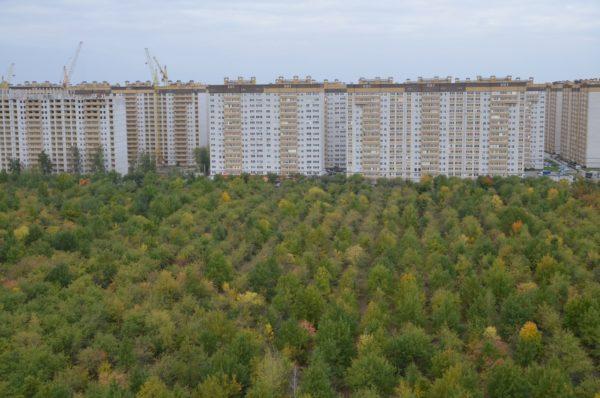
Voronezh apple garden
Mega-school vs. Apple orchard park // Мега-школа vs. парк яблоневый сад

[00:00]
So what is the best use of trees to help us meet our emission targets? Well, let’s go back to the tree top Trumps of election time. To lock up carbon you want a tree for the large trunk and dense wood. A pine is often seen as the best because they grow fast. You can pack them together. So I might raise you a hectare, a fast growing Sitka spruce, which would gobble up 200 tons of carbon in its lifetime – game over? Not quite

[00:27]
We did actually perform research that showed that natural regeneration of native woodlands on balance is actually a lot more effective as a climate mitigation strategy than using plantations. And one of the main reasons for this was despite the plantations often having a faster carbon sequestration rate than native woodlands, is this issue of the permanence of the carbon stocks. So how long they’re actually on the landscape for. And also because you have to factor in the carbon stocks that are on land prior to planting the trees, we may be planting in sort of degraded or disturbed forest habitats that need to be cleared.

[01:08]
These are actually areas that we really should be focusing on for restoration. You know, these are disturbed forests which are far more resilient because they already have species there. And if we leave them to regenerate, naturally, they’re going to be able to retain very high carbon stocks. But if we decide that actually these disturbed forests have no value and we want to clear them and put a timber plantation and that could lead to large emissions rather than actually any net benefit.

[01:34]
Charlotte’s research suggests that 45 percent of global commitments to tree planting are actually for short lived timber plantations. She believes we need more emphasis on natural regeneration and protecting the woodlands we already have because the carbon in these ecosystems will remain locked up and because their natural diversity means they’ll be much more resilient in the face of changing climate.

[02:00]
One important factor we have to think about is diversity in monoculture plantations in the UK. They can be very susceptible to disease. So things like ash dieback which have come into the UK are really important to consider when you’re looking at tree planting. But there were also pine related pest species that we need to really carefully monitor. We also need to look at genetic diversity in a plantation where you have planting a single species, not only probably planting just a single species of tree, but you may only be planting individuals from a limited number of parent trees.

[02:36]
So we need to be very, very careful about making sure we maintain genetic diversity within monoculture plantations as well, because that will make them more resilient to pests and to issues related to climate and changing climate in the future.

[02:50]
You’re listening to Cost in the Earth with Peter Gibbs, where I’m trying to find out whether ambitious tree planting schemes can really help us solve the climate crisis. Well, my local woodland here on the side of the Thames Valley is believed to be a remnant of the original Wildwood that covered Britain after the last ice age. But there are signs of stress here. I can see a lot of the ash around about is suffering from die-back disease, and also these hotter, drier summers that we’re seeing are really quite bad news for the shallow rooted beech trees.

[03:23]
Well, this is the forest of the past and present. But over in Sweden, Dr Henrik Shelman, scientific curator at the Guttenberg Botanical Garden, is standing in his Forest of the future, where he’s growing trees from different parts of the world to discover which might be most resilient to our future northern European climate.

[03:44] – Dr Henrik Shelman
The figures we can look into the crystal ball, a little bit, to see what kind of diseases are passed, do we have in the pipeline. The main thing is to invest in diversity, because if we have a big diversity and a disease common here, it’s all ashes or all alms that we have seen we still doesn’t lose that many trees. There’s still a lot of trees standing there and could cope. So what we need to do is broaden our catalogue of species to use.

[04:12]
Some of the popularity i think around this idea of planting trees to lock up carbon is, well, you know, a place like this that I’m standing in now, it’s a wonderful place to be. It’s very calming. But that means perhaps quite an emphasis on native trees. So like the oaks, like the beach, which might actually not be the best trees to be planting now when you’re thinking about 50, 100 years in the future.

[04:37] – Dr Henrik Shelman
That’s the big challenge when we talk about native trees and so on, that we might not be able to grow the native genetic matches of the species in future. We might have to work with a southern France or even East European or even Caucasus in Georgia. That kind of genetic material of the same species is maybe better adapted for future climate and so on. That’s the challenge, that’s the chance that the attitude towards that if we kind of create some kind of resilience, non-native, it’s the way to go, actually.

[05:11]
Although Henrich believes we need to look much further afield for the genetic material we use to make sure the trees don’t bring disease with them. We need to be growing them locally from seed.

[05:21] – Dr Henrik Shelman
I think the future is that we need to have more locally produced plants from the seed, from the cuttings, from the grafting that have to be on site in the area because there are fewer Nassiri they actually grow plant. It’s more like buying and selling. This is the biggest challenge we have when it comes to spreading diseases and pests because they are hitchhikers, not the plants fault that’s shipping. So I think the future is to have locally produced. But it’s also a challenge for, for example, the nursery in the UK because they have to change dramatically.

[05:56]
We heard from nurserymen Jamie Hurst at the start of the program. His nursery produces more than 13 million plants annually, but he feels they’re going to need a lot more support to meet the demand of these tree planting promises.

[06:10] – Jamie Hurst
We can’t step up to the mark. There is not enough seed at the moment, but the seed collectors aren’t going to step up to the mark. The whole supply chain, until we have certainty that these levels are going to be achieved. To get to these levels, we need major commercial forestry plantings to go on and to enable that, we need fiscal support to come in. Main nurseries who supply the forest industry already operating at 95 per cent capacity. We need investment in everything from infrastructure, land, people. Without people we can’t operate.

[06:48] – Jamie Hurst
We’re talking about capital here that is going to be required just at the time. We’re all taking a hit over with covid. If we’re going to achieve that sort of growth, we need significant fiscal support and we need it now to be able to deliver for 2025.

[07:07]
So it’s a big challenge to produce enough saplings here to meet targets, but then imports, risk bringing in devastating disease. So can we let nature do some of the hard work for us, instead? The perfectly named Isabella Tree is the best selling author of Wilding and Britton’s guru of rewilding. She firmly believes there is another way.

[07:30] – Isabella Tree
There’s a very engaging and sort of almost magnetic pull towards spades in the ground, but I don’t think it’s really the way to go about it. What we’ve seen at nap in our rewilding project is the tremendous benefits to biodiversity of allowing natural regeneration. So it’s really allowing thorny scrub, which is a kind of habitat that we have zero tolerance for in our landscapes. And we’ve almost forgotten about it. But it is actually the nursery for growing trees. And we knew this very well in the Middle Ages. There’s a lovely old foresters quote, which is “The Thorn is the mother of the oak”. And I think we lose something very important if we forget that natural regeneration is actually the most natural way of producing trees.

[08:22]
It’s also very low carbon. So if you think of the process of actually planting a tree that we’re familiar with today, which is putting saplings in the ground, which are produced in commercial nurseries, sometimes from abroad, often in Holland, you could be importing disease. That plant, that whip, the sapling itself is not connected to all the mycorrhizal fungi, that underground web of root fibre connections that give it that support from the moment it germinates. So you’re not producing saplings from the get go that are actually as strong and resilient as they could be.

[09:04]
And then you have a very high percentage loss. And what you get at the end of the day is a single generational plantation that eventually becomes closed canopy woodland, which is very species poor, very undynamic. That open wood pasture landscape with the thorny scrub is where you get the incredible biodiversity.

[09:25]
Paradoxically, promises made in the recent budget to plant woodlands the size of Birmingham might actually have less to offer than leaving smaller areas to naturally rewild into something much less densely canopied.

Trees living fast die young – ecology research

Trees living fast die young

Trees living fast die young
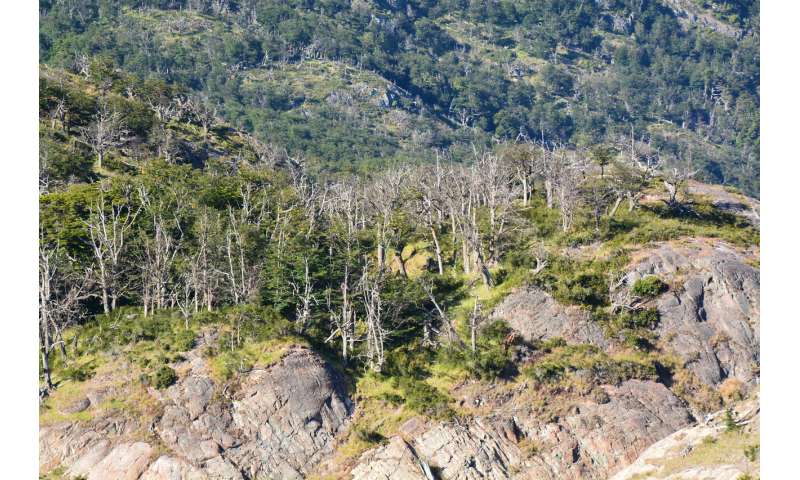
Nothofagus pumilio (southern beeches) forests around Lago Argentino, in the Andes of southern Patagonia, Argentina, showing groups of dead trees in relation to the severe drought during the austral summer 2011-2012. Increment cores from dead trees provide ages ranging from 150 to 300 years for these individuals. Credit: Ricardo Villalba, Instituto Argentino de Nivología, Glaciología y Ciencias Ambientales (IANIGLA-CONICET).

A global analysis reveals for the first time that across almost all tree species, fast growing trees have shorter lifespans. This international study further calls into question predictions that greater tree growth means greater carbon storage in forests in the long term.

Currently, forests absorb large amounts of  dioxide (CO2) from the atmosphere. This is thought to be due to higher temperatures and abundant CO2 stimulating growth in , allowing them to absorb more CO2 as they grow.

Most earth system models predict that this growth stimulation will continue to cause a net carbon uptake of forests this century. But, the study, led by the University of Leeds and published today in Nature Communications, casts doubts on these predictions.

The international study is the largest to date looking at the relationship between tree growth and tree lifespan. The researchers examined more than 200 thousand tree-ring records from 82 tree species from sites across the globe.

It confirms that accelerated growth results in shorter tree lifespans, and that growth-lifespan trade-offs are indeed near universal, occurring across almost all  and climates. This suggests that increases in  carbon stocks may be short lived.

Lead author of the study, Dr. Roel Brienen from the School of Geography at Leeds, said: “While it has been known for a long time that fast-growing trees live shorter, so far this was only shown for a few species and at a few sites.

Trees living fast die young
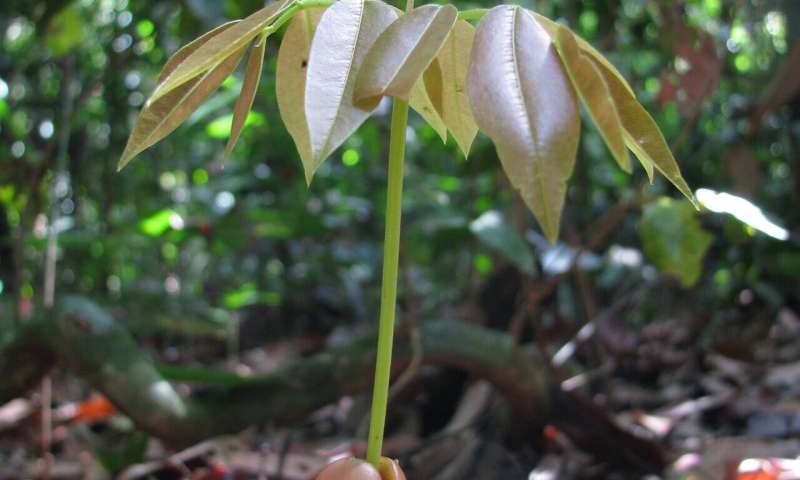
Tree seedling starting its life in the rainforest, Peru. Credit: Roel Brienen, University of Leeds

“We started a global analysis and were surprised to find that these trade-offs are incredibly common. It occurred in almost all species we looked at, including tropical trees.

“Our modelling results suggest there is likely to be a time lag before we see the worst of the potential loss of carbon stocks from increases in tree mortality. They estimate that global increases in tree death don’t kick in until after sites show accelerated growth.

“This is consistent with observations of increased tree death trends across the globe. For example, previous Leeds research has shown long-term increases in tree mortality rates lagging behind tree growth increases in the Amazon forest.”

Co-author Prof Manuel Gloor, also from the School of Geography, said: “Earth system models often do not, or cannot by design, take into account this negative feedback, and model projections of the global forest carbon sink persistence are thus likely inaccurate and too optimistic. Our findings imply that a much reduced future forest carbon sink further increases the urgency to curb greenhouse emissions.”

The trade-off may be due to environmental variables affecting  and lifespan. For example, co-author, Dr. Alfredo Di Filippo from Tuscia University, Italy previously reported that lifespan of beech trees in the Northern Hemisphere decreases by roughly 30 years for each degree of warming.

Trees living fast die young
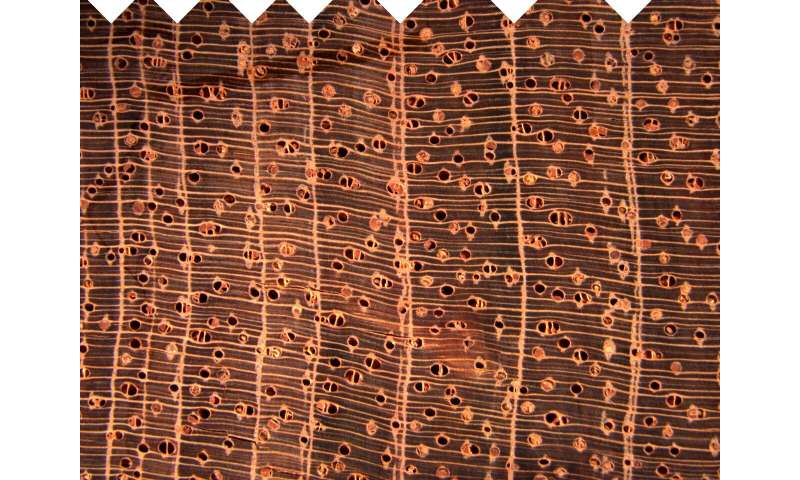
Tree rings of Hymenaea courbaril (Leguminosae) from the Neotropics. These tree rings formed during the wet season are delimited by visually distinct bands known as marginal parenchyma bands (limits indicated by the white arrows). Credit: Giuliano M. Locosselli and Milena Godoy-Veiga

The current analysis confirms that, across biomes, reductions in lifespan are not due directly to temperature per se, but are a result of faster growth at warmer temperatures.

Their findings suggests that a prominent cause of the widespread occurrence of a growth lifespan trade-off is that chances of dying increase dramatically as trees reach their maximum potential tree size.

Nonetheless, other factors may still play a role as well. For example, trees that grow fast may invest less in defences against diseases or insect attacks, and may make wood of lower density or with water transport systems more vulnerable to drought.

Study co-author Dr. Steve Voelker, from the Department of Environmental and Forest Biology, Syracuse, New York, said: “Our findings, very much like the story of the tortoise and the hare, indicate that there are traits within the fastest growing trees that make them vulnerable, whereas slower growing trees have traits that allow them to persist.

“Our society has benefitted in recent decades from the ability of forests to increasingly store carbon and reduce the rate at which CO2 has accumulated in our atmosphere. However, carbon uptake rates of forests are likely to be on the wane as slow-growing and persistent trees are supplanted by fast-growing but vulnerable trees.”

Forests of the Future

by BBC

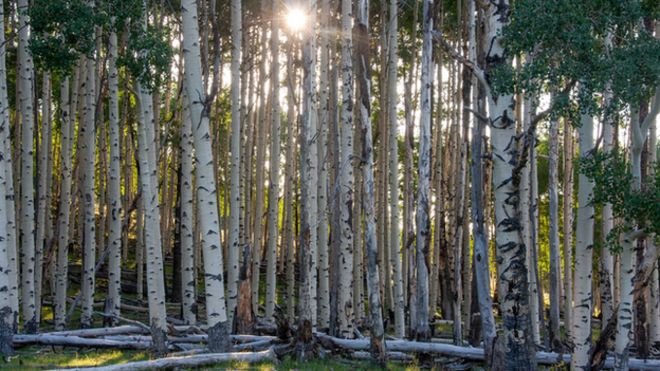
Aspen trees (Image: Martin Venturas)Image copyrightM.VENTURAS
Image captionResearchers found that trees could be surprisingly resilient to increased warming and CO2 levels

Forests can cope with a warming world if – and only if – temperature rises increase in line with increases in atmospheric carbon dioxide.

Increased CO2 allows trees to develop physiological characteristics, such as greater foliage, that can cope with higher temperatures.

But researchers warn that a break in the temperature-CO2 increase ratio could trigger mortality in forests.

The findings appear in the Proceedings of the National Academy of Sciences.

“Nobody had really considered incorporating the ability of trees, the forests, to adjust to novel conditions and to acclimate,” explained co-author John Sperry from the University of Utah.

“So it felt like we were bringing in two new approaches to this longstanding question of whether CO2 or warming were going to play out in the future.”

Delicate balancing act

Higher levels of atmospheric CO2 allow trees to consume relatively less water and photosynthesise more, whereas increased temperatures result in trees consuming more water and photosynthesising less.

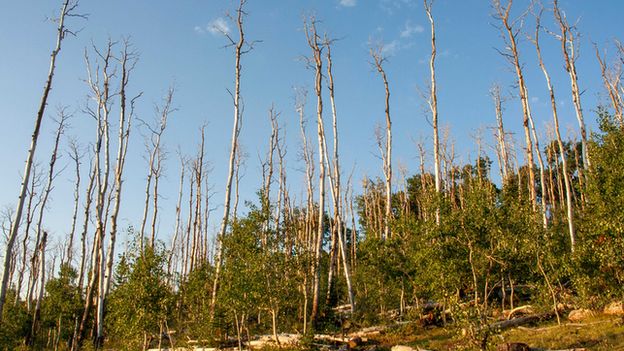
Drought-induced mortality of trees (Image: Martin Venturas)Image copyrightM.VENTURAS
Image captionToo much warming without a corresponding increase in CO2 levels could trigger a vast die-off of trees, the study warns

Using a unique model that took into account the trees’ physiology, Prof Sperry and his colleagues reached a rather surprising conclusion.

“What’s interesting is that it is not the magnitude of the CO2 increase or the magnitude of the warming, it was the ratio of the two,” he told BBC News.

“For example, it was interesting to see that the low emissions scenario is actually predicted to be closer to the tipping point; closer to the critical ratio than the higher emissions scenario.

“That’s simply because in the lower emissions scenario, the ratio of CO2 increase for warming is lower.”

Co-author Martin Venturas said the team did not find many differences between species in the study, which covered 20 locations across the mainland of the US, and included both deciduous and conifer species.

But Dr Venturas added: “There is still a huge amount of uncertainty, despite the fact that we have reduced uncertainty related to the physiology of the forest.”

One such uncertainty, he explained, was precipitation levels in a changing climate and how this change affected soil moisture levels.

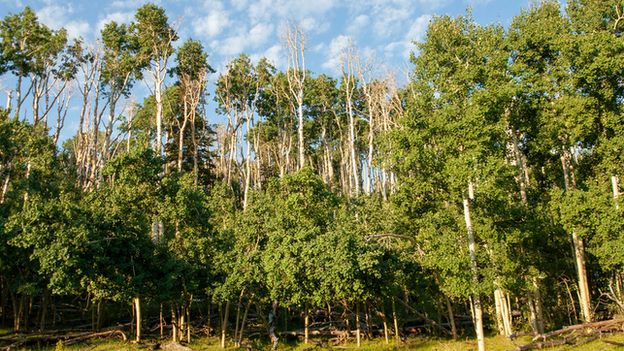
Drought-induced dieback among treesImage copyrightM.VENTURAS
Image captionUnder the right conditions, the model suggests trees are surprisingly resilient to some of the effects of climate change

However, the researchers said the study findings helped move the debate forward.

“If you were coming at this naively, you would think the more emissions, the worse the forest was going to be affected because it was going to get warmer,” observed Prof Sperry.

“But it is really the ratio of the two that is important. You can have a massive shift in CO2 and warming but as long as they travel along that neutral ratio, the force is physiologically neutral and you’ll have no response.”

Forest regeneration camp on Lake Baikal (24-28 Sep 2020)

Forest regeneration camp on Lake Baikal (24-28 Sep 2020)

Forest Camp

ALL-RUSSIAN VOLUNTEER REFORESTATION CAMP

The history of the forest restoration camp began in Baikal region with the initiative of people who are not indifferent to help reforestation after the devastating fires in 2015. Then burned > 1.5 million hectares, which is half the area of Belgium.

In autumn 2015, the first planting took place on the island of Olkhon, where there were huge burned areas. Camp volunteers decided to engage in the restoration of the Baikal taiga, because at that time they already had experience in forestation: since 2012, the volunteers conducted a traditional campaign in Irkutsk ‘‘Plant a tree – Give Life to the Planet’’ in Kayskaya Grove (at the moment the project is completed).


In 2016, camp volunteers raised funds on crowdfunding platform «Boomstarter», which not only planted a new forest, but also built an effective fence to protect the Baikal Riviera – Sarai Bay from the spontaneous movement of traffic on Lake Olkhon.

История работы лесного восстановительного лагеря началась в Прибайкалье с инициативы неравнодушных жителей помочь лесовосстановлению после сильнейших пожаров в 2015 году. Тогда сгорело > 1,5 млн Га, что составляет половину площади Бельгии.

Осенью 2015 года состоялась первая посадка на острове Ольхон, где находились огромные сгоревшие территории. Волонтёры лагеря приняли решение заняться восстановлением байкальской тайги, поскольку на тот момент у них уже был опыт лесопосадок: c 2012 года волонтёры проводили традиционную акцию в Иркутске «Посади дерево – Подари Планете Жизнь» в Кайской Роще (на данный момент проект завершён).

В 2016 году волонтёры лагеря собрали средства на краудфандинговой платформе ‘‘Boomstarter’’, благодаря которым не только был посажен новый лес, но и построено эффективное ограждение для защиты байкальской ривьеры – Сарайского залива от стихийного передвижения транспорта на озеро Ольхон.

Announcement and Review of the 2020 Camp (September 24-28)

Anton Potapov, Vlad Tishchenko

All the teams will be participating in the Accelerator programme

Все команды будут участвовать в программе Акселератор

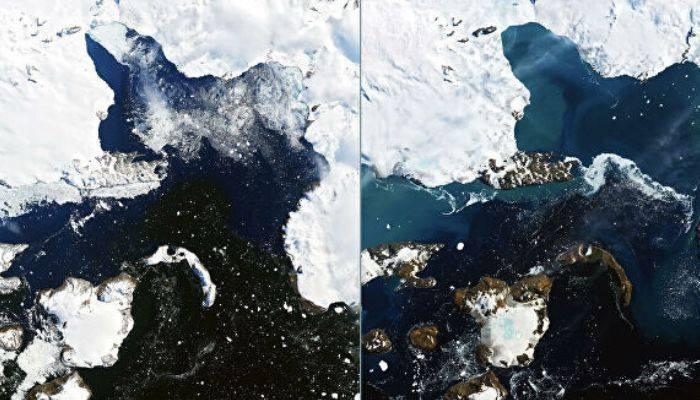
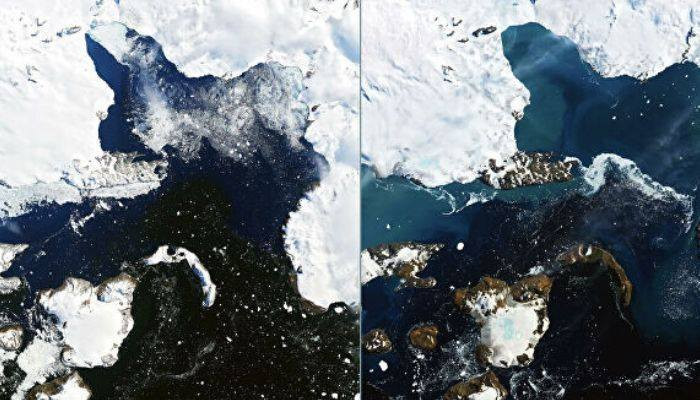
Sea level rise from ice sheets track worst-case climate change scenario (31.08.2020)

Sea level rise from ice sheets track worst-case climate change scenario

04 September, 2020
Sea level rise from ice sheets track worst-case climate change scenario

Ice sheets in Greenland and Antarctica whose melting rates are rapidly increasing have raised the global sea level by 1.8cm since the 1990s, and are matching the Intergovernmental Panel on Climate Change’s worst-case climate warming scenarios.

According to a new study from the University of Leeds and the Danish Meteorological Institute, if these rates continue, the ice sheets are expected to raise sea levels by a further 17cm and expose an additional 16 million people to annual coastal flooding by the end of the century.

Since the ice sheets were first monitored by satellite in the 1990s, melting from Antarctica has pushed global sea levels up by 7.2mm, while Greenland has contributed 10.6mm. And the latest measurements show that the world’s oceans are now rising by 4mm each year.

“Although we anticipated the ice sheets would lose increasing amounts of ice in response to the warming of the oceans and atmosphere, the rate at which they are melting has accelerated faster than we could have imagined,” said Dr. Tom Slater, lead author of the study and climate researcher at the Centre for Polar Observation and Modelling at the University of Leeds.

“The melting is overtaking the  we use to guide us, and we are in danger of being unprepared for the risks posed by  rise.”

The results are published today in a study in the journal Nature Climate Change. It compares the latest results from satellite surveys from the Ice Sheet Mass Balance Intercomparison Exercise (IMBIE) with calculations from climate models. The authors warn that the ice sheets are losing ice at a rate predicted by the worst-case climate warming scenarios in the last large IPCC report.

glacial lagoon
glacial lagoon

Dr. Anna Hogg, study co-author and climate researcher in the School of Earth and Environment at Leeds, said: “If  losses continue to track our worst-case climate warming scenarios we should expect an additional 17cm of  from the ice sheets alone. That’s enough to double the frequency of storm-surge flooding in many of the world’s largest coastal cities.”

So far, global sea levels have increased in the most part through a mechanism called , which means that volume of seawater expands as it gets warmer. But in the last five years, ice melt from the ice sheets and mountain glaciers has overtaken global warming as the main cause of rising sea levels.

Dr. Ruth Mottram, study co-author and  researcher at the Danish Meteorological Institute, said: “It is not only Antarctica and Greenland that are causing the water to rise. In recent years, thousands of smaller glaciers have begun to melt or disappear altogether, as we saw with the glacier Ok in Iceland, which was declared “dead” in 2014. This means that melting of ice has now taken over as the main contributor of sea level rise. ”

The study, “Ice-sheet losses track high-end sea-level rise projections,” is published today (31 August) in Nature Climate Change.

Voronezh has become a Tree City of the World!

The Food and Agricultural Organization of the United Nations (FAO) and the Arbor Day Foundation Recognize Voronezh as a Tree City

Tree city

Яго Кин, Великобритания: “Воронеж заслужил того, чтобы его признали городом деревьев мира.”

Voronezh, Russia (6 February, 2020) –

The Food and Agriculture Organization of the United Nations (FAO) along with the Arbor Day Foundation has recognized Voronezh with Tree Cities of the World designation.

The international programme celebrates cities across all continents that meet core standards for the care and planning of urban trees and forests.

To achieve recognition, Voronezh met the five core standards: establish responsibility, set the rules, know what you have, allocate the resources and celebrate achievements.

“The Tree Cities of the World programme recognizes the efforts cities take toward greener, healthier communities,” said Hiroto Mitsugi, assistant director general, Forestry Department, FAO.

Воронеж, Россия (6 февраля 2020 года) – Продовольственная и сельскохозяйственная организация ООН (ФАО) совместно с Фондом Дня посадки дерева признали Воронеж с получением статуса Города деревьев мира.

Международная программа отмечает города на всех континентах, которые соответствуют ключевым стандартам по планированию и уходу за деревьями и лесами города.

Чтобы получить признание, Воронеж должен был соответствовать пяти ключевым стандартам: установление ответственности, установление правил, подтверждение того, что имеется, выделение ресурсов и отметка достижений.

 «Программа «Города деревьев мира» отмечает, что города прилагают усилия к созданию более экологичных, здоровых сообществ», – сказал Хирото Мицуги, ассистент генерального директора Департамента лесного хозяйства ФАО.

Voronezh has become a Tree City of the World!

“Voronezh joins cities around the world that have taken steps toward robust and healthy city forests,” said Dan Lambe, president, Arbor Day Foundation.

“Trees clean our air and water, provide shade, and beautify the places we live and work.This designation signifies Voronezh’s commitment to being a healthier, happier city.”

The Tree Cities of the World programme is built off the success of the Arbor Day Foundation’s Tree City USA program, which has provided recognition to cities within the United States for more than 40 years.The vision of the Tree Cities of the World programme is to connect cities around the world in a new network dedicated to sharing and adopting the most successful approaches to managing city trees and forests.


Trees provide multiple benefits to a city when properly planted and maintained.They help to improve the visual appeal of a neighborhood, increase property values, reduce home cooling costs, remove air pollutants and provide wildlife habitat, among many other benefits.

More information is available at TreeCitiesoftheWorld.org.

FAO

About the FAO

Established in 1945, the Food and Agriculture Organization of the United Nations (FAO), is a Specialized Agency of the United Nations system that leads international efforts to defeat hunger.

The Organization is comprised of 194 Member States, 2 associate  members  and  1  member organization – The European Union.

Its aim is to raise levels of nutrition and standards of living for all people in FAO member countries, to secure improvements in the efficiency of production and distribution of food and agricultural products, to ensure the sustainable management of natural resources and to contribute towards expanding the world economy and ensure humanity’s freedom from hunger.


FAO is currently present in over 130 countries.

More information is available at www.fao.org

About the Arbor Day Foundation

Founded in 1972, the Arbor Day Foundation has grown to become the largest nonprofit membership organization dedicated to planting trees, with more than one million members, supporters and valued partners.

Since 1972, more than 350 million Arbor Day Foundation trees have been planted in neighborhoods, communities, cities and forests throughout the world.

«Воронеж присоединяется к городам всего мира, которые предприняли меры к созданию надежных и здоровых городских лесов», – сказал Дэн Ламбэ, председатель Фонда Дня посадки дерева.

«Деревья очищают наш воздух и воду, дают тень и украшение местам, где мы живем и работаем. Этот статус означает стремление города Воронежа  стать более здоровым и счастливым городом».

Программа «Города деревьев мира» вышла из успешной программы Фонда Дня посадки дерева «Город деревьев США», которая более 40 лет получала признание в городах США. Концепция программы «Города деревьев мира» предназначена объединять города всего мира в новую сеть, посвященную обмену и внедрению наиболее успешных концепций организации городских деревьев и лесопарков.


Деревья обеспечивают множество преимуществ для города, если они правильно посажены и поддерживаются. Они помогают улучшить визуальную привлекательность района, увеличить стоимость собственности, сократить расходы на охлаждение дома, удалить загрязнение воздуха и обеспечить среду обитания диких животных и многие другие преимущества.

Больше информации доступно по ссылке TreeCitiesoftheWorld.org.

О ФАО 

Созданная в 1945 году Продовольственная и сельскохозяйственная организация Объединенных Наций (ФАО) является специализированным учреждением системы Организации Объединенных Наций, которое ведет международную работу по борьбе с голодом.

В состав Организации входят 194 государства-члена, 2 ассоциированных члена и 1 организация-член — Европейский союз.


Ее цель заключается в повышении уровня питания и уровня жизни для всех людей в странах — членах ФАО, повышении эффективности производства и распределения продовольствия и сельскохозяйственной продукции, обеспечении устойчивого управления природными ресурсами и содействии расширению мира экономики и обеспечить человечеству свободу от голода.

В настоящее время ФАО представлена более чем в 130 странах.

Более подробная информация доступна на сайте www.fao.org

О Фонде Дня посадке дерева

Основанный в 1972 году Фонд Дня посадки дерева стал самой большой некоммерческой организацией, которая занимается посадкой деревьев и имеет более чем один миллион членов, сторонников и ценных партнеров.

С 1972 г. более чем 350 миллионов деревьев Фонда Дня древонасаждения было высажено в районах, общинах, городах и лесах во всем мире.

Vlad Tishchenko

Some of you may already have faced a challenge in getting green infrastructure accepted by decision makers. A common question, a common barrier, is why should we bother investing in green infrastructure? What’s in it for us? Why bother?

For some, it is easy to understand. They get it. We are amongst those that understand its value. The organisers of the “Green Infrastructure” conference, the Department of Natural Resources and Ecology of the Voronezh region understand it and value it.

The city council of Voronezh and the Ecology office of the city took the main part in the recognition of Voronezh, indicating the entire regulatory framework, as well as the person responsible for the maintenance of green spaces.

Congratulations to the mayor on Earning Tree Cities

of the World Recognition for 2019!

Dear Vadim,

On behalf of the Arbor Day Foundation and the Food and Agriculture Organization of the United Nations, we write to congratulate Voronezh on earning 2019 Tree Cities of the World recognition. As part of the inaugural class, residents of Voronezh should be proud to live in a city that makes the planting and care of trees a priority. Congratulations for earning this prestigious status!

Now more than ever, trees and forests are a vital component of healthy, livable, and sustainable communities around the globe. As a result of your commitment to effective urban forest management, Voronezh is helping to provide a solution to these global challenges.

Уважаемый Вадим Юрьевич,

От имени Фонда «День посадки деревьев» и Продовольственной и сельскохозяйственной организации Объединенных Наций мы пишем, чтобы поздравить Воронеж с получением статуса «Города деревьев мира». Жители Воронежа должны гордиться тем, что живут в городе, который делает посадку и уход за деревьями приоритетом. Поздравляем с получением этого престижного статуса!

Сейчас более чем когда-либо деревья и леса являются жизненно важным компонентом здоровых, пригодных для жизни и устойчивых сообществ по всему миру. В результате вашей приверженности к эффективному управлению городскими лесами Воронеж помогает решить эти глобальные проблемы.

New Russian Vaccine – Lancent research

By Jonny Tickle

The world’s first registered Covid-19 vaccine successfully produced antibodies in all 76 participants in early-stage trials, according to a study published in The Lancet, one of the oldest and best-respected medical journals.

Добавьте описание

The trials of ‘Sputnik V,’ funded by the Russian Ministry of Health, discovered that every single patient who received the vaccine developed antibodies, and none showed any significant side effects.

On August 11, Russian President Vladimir Putin announced that the country had registered the world’s first Covid-19 vaccine. Developed by Moscow’s Gamaleya Research Institute of Epidemiology and Microbiology, the formula will first be distributed to teachers and medical workers before being made available to the general public next year.

ALSO ON RT.COM As world’s first Covid-19 vaccine, Sputnik V, enters third phase trial, elderly scientists successfully test it on themselves

Following its registration, scientists and epidemiologists worldwide criticized Russia for the vaccine’s rapid development, questioning its safety due to the small number of trial subjects. Although the testing was successful, longer-term trials, including a placebo comparison, are required to establish its actual quality, according to The Lancet.

However, according to the Russian Direct Investment Fund (RDIF), the scientific data provided in the article proves the “safety and effectiveness of the Russian vaccine.”

Explaining why it took a month to publish the results, Gamaleya Institute head, Alexander Gintsburg, told Russian news agency Interfax that it took a long time to prepare, and the article was evaluated by five independent reviewers, following all standard international peer-review conventions.

“The scientific community has assessed it quite objectively,” he explained.

ALSO ON RT.COM White House rejects ‘corrupt’ WHO concerns over Covid-19 vaccine development

Despite its well-earned reputation, The Lancet has not been immune from controversy. Earlier this year, the journal published a study refuting the effectiveness of malaria drug hydroxychloroquine against Covid-19, but it was later withdrawn due to multiple errors.

Russia is not the only country racing to develop an effective vaccine against coronavirus. In July, a coronavirus vaccine developed by the University of Oxford was reported as creating immunity in a trial of 1,077 people. Earlier that month, UK security minister James Brokenshire claimed that Russian hackers had attacked British labs to steal vaccine research data.

Protected: EnglishMag new edition pdf file

This content is password-protected. To view it, please enter the password below.

EnglishMag online 1Q/2020 (demo edition)

I am PDF block.

Voting for the best projects of the All-Russian competition for the development of ecotourism is in full swing.

Voting for the best projects of the All-Russian competition for the development of ecotourism is in full swing

All-Russian competition for the development of ecotourism: 115 teams and 68 regions

Завершился прием заявок на Всероссийский конкурс развития экотуризма, но голосование за лучших в прямом разгаре. Отклик от команд, начиная с Калининградской области и заканчивая Сахалином, говорит об актуальности вопроса развития особо охраняемых природных территорий.

Главная цель эко-конкурса – выявление пилотных территорий по развитию экологического туризма в части создания туристско-рекреационных кластеров в рамках комплексного развития особо охраняемых природных территорий, а также прилегающих к ним. Всё это  способствует развитию малого и среднего предпринимательства, росту занятости и доходов населения регионов РФ, развитию сельских территорий, стимулированию взаимодействия между органами государственной власти, предпринимателями и местными жителями.

The application process for the All-Russian competition for the development of ecotourism comes to an end, but voting for the best projects is in full swing. The response from the teams, starting from the Kaliningrad region and ending with Sakhalin, speaks of the relevance of the issue of the development of specially protected natural areas.


The main goal of the eco-competition is to identify pilot territories for the development of ecological tourism in terms of creating tourist and recreational clusters within the framework of the integrated development of specially protected natural areas, as well as adjacent to them. All this contributes to the development of small and medium-sized businesses, the growth of employment and incomes of the population of the regions of the Russian Federation, the development of rural areas, and the stimulation of interaction between government bodies, entrepreneurs and local residents.

Applications include projects

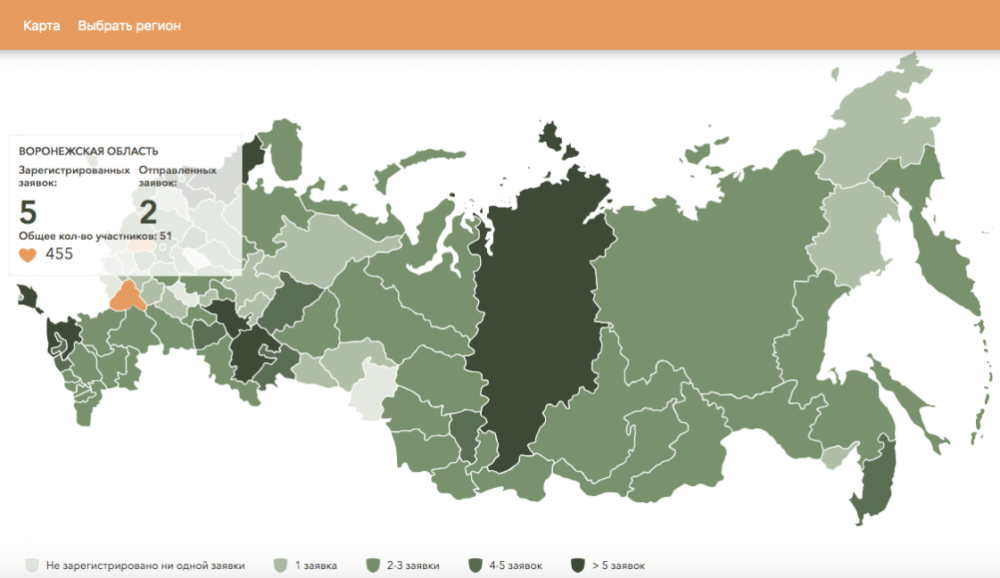
Многие представленные заявки включают проекты, направленные на развитие сразу нескольких особо охраняемых природных территорий (ООПТ). Общая площадь участвующих в соревновании территорий составляет 58 млн га, это почти четверть всех ООПТ страны. Больше всего заявок было подано из Республики Карелия, где на победу претендует шесть команд. Участники готовили свои проекты и заполняли заявки на сайте проекта priroda.life. Особенностью конкурса было, что нельзя было затрагивать ООПТ, которые имеют ограничения на посещения в связи с важной природной составляющей.

“Конкурс, в первую очередь, позволит сформировать у специалистов ООПТ новый взгляд на природную территорию как на привлекательный для посетителей и уникальный комплекс, имеющий огромный эколого-туристский и эколого-просветительский потенциал”, – сказал министр природных ресурсов и экологии РФ Дмитрий Кобылкин, отметив, что при развитии экотуризма не стоит забывать, что основная цель ООПТ – сбережение природных богатств России.

Голосование за проекты

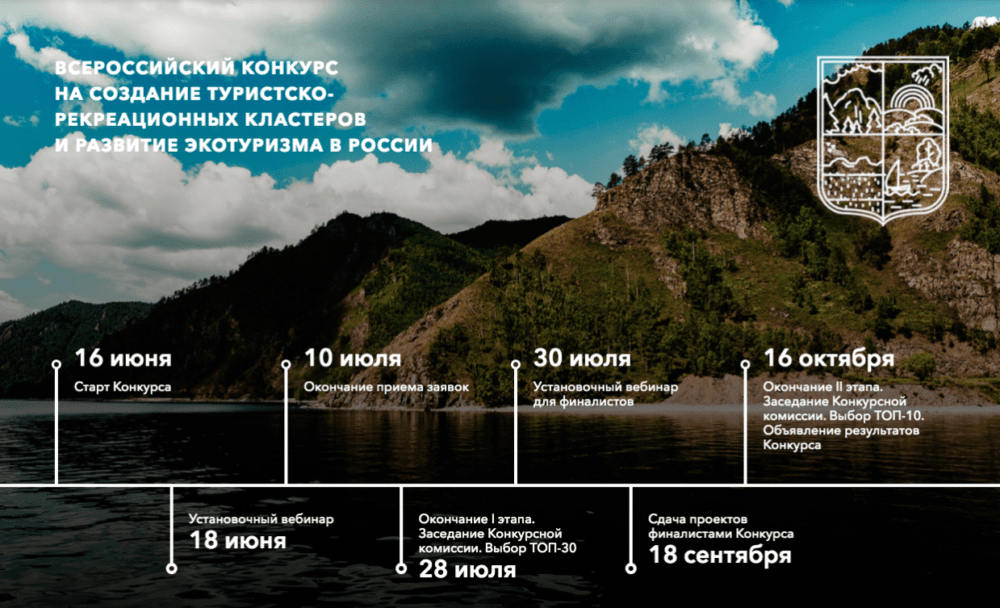
Проголосовать за проекты своего или любого другого региона можно с 13 по 23 июля. Участвовать могут только пользователи, зарегистрированные на сайте. Каждый может голосовать за неограниченное количество проектов из любых регионов, но за 1 проект только единожды. Далее конкурсная комиссия выберет 30 лучших, по ее мнению, заявок, междисциплинарные команды которых смогут участвовать в специально разработанной акселерационной программе. Решение конкурсной комиссии будет объявлено 28 июля.

В рамках акселератора 30 команд получат возможность разработать комплексные проекты туристско-рекреационных кластеров по развитию экотуризма и затем представить их органам власти регионов, потенциальным инвесторам и администрациям регионов.

Конкурс проходит при поддержке четырех профильных ведомств России: Министерства природных ресурсов и экологии, Министерства экономического развития, Министерства по развитию Дальнего Востока и Арктики и Ростуризма.

Many submitted applications include projects aimed at the development of several specially protected natural areas (PAs). The total area of ​​the territories participating in the competition is 58 million hectares, which is almost a quarter of all protected areas in the country. Most applications were submitted from the Republic of Karelia, where six teams claim to win. The participants prepared their projects and filled out applications on the priroda.life project website. The peculiarity of the competition was that it was impossible to touch the natural protected areas, which have restrictions on visits due to an important natural component.


“The competition, first of all, will allow the specialists of the specially protected natural areas to form a new view of the natural territory as an attractive for visitors and a unique complex with a huge ecological-tourist and ecological-educational potential,” said the Minister of Natural Resources and Ecology of the Russian Federation Dmitry Kobylkin, noting that when developing ecotourism, one should not forget that the main goal of protected areas is to preserve the natural resources of Russia.

Voting for projects


You can vote for projects in your own or any other region from 13 to 23 July. Only registered users can participate. Everyone can vote for an unlimited number of projects from any region, but for 1 project once only. Furthermore, the competition committee will select the 30 best, in its opinion, applications, the interdisciplinary teams of which will be able to participate in a specially developed acceleration program. The decision of the competition committee will be announced on July 28.


Within the framework of the accelerator, 30 teams will have the opportunity to develop complex projects of tourist and recreational clusters for the development of ecotourism and then present them to regional authorities, potential investors and regional administrations.


The competition is supported by four specialized departments of Russia: the Ministry of Natural Resources and Environment, the Ministry of Economic Development, the Ministry for the Development of the Far East and the Arctic, and Rostourism.

How can you vote for the projects you like?

Более подробно о конкурсе можно узнать в образовательных вебинарах Вячеславом Ивановым и другими организаторами конкурса: https://youtu.be/m_Q33iImogY?t=105

Такие вебинары будут полезны для подачи заявок и на будущие конкурсы.

Источники:

  1. https://priroda.life/contest/
  2. https://tass.ru/obschestvo/8955003

P.S. нужно отметить, что ежегодный доход природных территорий в России составляет $17 млн. Это в 1061 раз меньше, чем в США. Несмотря на то что 56 млн россиян проживают в радиусе 30 км от федеральных ООПТ, лишь 12% посещали природные заповедники и национальные парки в последние 3 года.

More details about the competition can be found in educational webinars by Vyacheslav Ivanov and other organizers of the competition: https://youtu.be/m_Q33iImogY?t=105

Such webinars will be useful for submitting applications for future contests.


Sources:

  1. https://priroda.life/contest/
  2. https://tass.ru/obschestvo/8955003

P.S. It should be noted that the annual income from natural touristic areas in Russia is $ 17 million. This is 1,061 times less than in the United States. Despite the fact that 56 million Russians live within a radius of 30 km from federal protected areas, only 12% have visited natural reserves and national parks in the past 3 years.

Anton Potapov, Vlad Tishchenko

All the teams will be participating in the Accelerator programme

Все команды будут участвовать в программе Акселератор

Презентация вебинара Подготовительного модуля. 23.06. Формирование команды и выбор территории